

Bright sunlight, low-angle sun, reflective roads, and powerful headlights can create some of the most difficult recording conditions for a dash cam.
You may notice that footage looks perfectly clear under normal conditions but suddenly becomes washed out when driving toward the sun. At night, headlights from an approaching vehicle may appear as bright white spots, making surrounding details—and sometimes license plates—much harder to see.
So why does this happen?
And more importantly, how do dash cams reduce glare from sunlight and headlights?
Modern dash cams rely on a combination of dynamic range, image sensors, HDR or WDR processing, exposure control, lens quality, and image signal processing to handle extreme differences between bright and dark areas.
This guide explains why glare happens, which dash cam technologies actually help, and what you can do to improve your own footage.
What Is Glare in Dash Cam Footage?
Glare occurs when an intense light source overwhelms part of the camera's image.
Common sources include:
- Direct sunlight
- Sunrise and sunset
- Oncoming headlights
- High-beam headlights
- LED headlights
- Streetlights
- Reflective license plates
- Wet roads
- Snow
- Windshield and dashboard reflections
The problem becomes especially difficult when very bright and very dark areas appear in the same frame.
Imagine driving on a dark road at night.
The road itself may receive very little light, while an approaching vehicle's headlights are extremely bright. Your dash cam has to expose both areas at the same time.
If exposure is optimized for the dark road, the headlights may become overexposed.
If exposure is reduced for the headlights, darker parts of the road may lose detail.
This difference between the darkest and brightest parts of a scene is one reason dynamic range matters so much in dash cam image quality.
Why Does Bright Sunlight Cause Dash Cam Glare?
Direct sunlight creates several challenges for a camera.
Extreme Brightness
When the sun enters the camera's field of view, its brightness can exceed what the image sensor can accurately capture.
The result may include:
- Washed-out highlights
- Reduced contrast
- Loss of road detail
- Lens flare
- Haze
- Reduced license plate visibility
This is particularly noticeable when driving directly toward the sun.
Sunrise and Sunset Create High-Contrast Scenes
Low-angle sunlight is often more challenging than midday sunlight.
During sunrise or sunset, the sun may be directly ahead while buildings, vehicles, trees, and the road remain relatively dark.
The dash cam therefore needs to preserve information in both:
very bright highlights + dark shadows
A camera with limited dynamic range may struggle to retain both.
Windshield Reflections Can Make Glare Worse
Not all glare comes from outside the vehicle.
Light can reflect from your dashboard onto the windshield and become visible in dash cam footage.
Bright or reflective objects placed on the dashboard can make the problem worse.
You may notice reflections from:
- Dashboard surfaces
- Papers
- Phones
- Navigation screens
- Decorative objects
- Light-colored clothing or objects
These reflections can reduce contrast and make footage look hazy even when the road itself is clearly visible.
Why Do Headlights Cause So Much Glare at Night?
Nighttime creates the opposite problem.
Instead of too much overall light, the dash cam has to work with very little ambient light plus a few extremely bright light sources.
For example:
Dark road + bright LED headlights + reflective license plate
This is an extremely high-contrast scene.
If the camera increases exposure to make the dark road visible, headlights can become overexposed.
This may create:
- Large white areas around headlights
- Reduced vehicle detail
- Washed-out license plates
- Loss of nearby road markings
- Reduced contrast around the approaching vehicle
Wet roads can make the situation even harder because water reflects headlights, traffic lights, signs, and streetlights back toward the camera.
How Do Dash Cams Reduce Sunlight and Headlight Glare?
No single technology completely eliminates glare.
A good dash cam uses an entire imaging system to manage difficult lighting conditions.
Here are the technologies that matter most.
1. HDR Helps Balance Bright and Dark Areas
HDR (High Dynamic Range) is one of the most important technologies for handling high-contrast driving scenes.
Instead of allowing extremely bright areas to dominate the image while shadows disappear, HDR is designed to preserve a wider range of brightness information.
This can help when recording:
- Oncoming headlights
- Sunrise and sunset
- Tunnel entrances and exits
- Bright road signs
- Reflective license plates
- Streetlights
- Mixed urban lighting
For example, imagine an approaching car at night.
Without effective dynamic-range processing:
Headlights → extremely bright
Road → dark
Vehicle details → difficult to see
With well-implemented HDR:
Highlights → better controlled
Shadows → more detail preserved
Overall exposure → more balanced
However, HDR should not be treated as a magic solution.
Its effectiveness depends on the image sensor, processor, exposure strategy, camera tuning, motion, and lighting conditions.
2. WDR Helps Manage High-Contrast Scenes
You may also see WDR (Wide Dynamic Range) listed on dash cam specifications.
Like HDR, WDR is intended to help the camera preserve usable information when bright and dark areas exist within the same scene.
This can be useful when:
- Driving toward bright sunlight
- Moving through areas with strong shadows
- Entering or leaving tunnels
- Driving at night with oncoming traffic
- Recording illuminated signs against dark backgrounds
The exact implementation of HDR and WDR varies between cameras.
For buyers, the important question is not simply:
“Does this dash cam have HDR or WDR?”
A better question is:
“How well does this dash cam actually control highlights and preserve shadow detail in real-world footage?”
Real driving footage is often more informative than a specification alone.
3. Image Sensor Quality Affects Glare Performance
The image sensor is the foundation of dash cam image quality.
A capable sensor can capture a wider range of light information before image processing takes place.
This becomes particularly important when a scene contains both:
- Bright highlights
- Dark shadows
Modern automotive imaging sensors such as Sony STARVIS 2 are designed to improve imaging performance in challenging lighting environments.
A higher-quality sensor can contribute to:
- Better low-light sensitivity
- Improved dynamic range
- Cleaner shadow detail
- Better highlight control
- Reduced image noise
- More usable nighttime footage
This is why two dash cams recording at the same resolution can produce very different results.
A camera labeled “4K” does not automatically have better glare control than every 2K camera.
Resolution determines how many pixels are recorded.
It does not, by itself, determine how well those pixels handle extreme light.
4. The ISP Continuously Adjusts the Image
Inside a modern dash cam is an Image Signal Processor (ISP).
The ISP takes raw information captured by the image sensor and converts it into the video you eventually see.
It may control or influence:
- Exposure
- White balance
- Noise reduction
- Contrast
- Color
- Sharpening
- Highlight control
- Shadow detail
This happens continuously while you drive.
Consider entering a tunnel during a sunny afternoon.
Outside:
Bright sunlight
Inside:
Low light
At the exit:
Sudden intense brightness
The camera needs to respond rapidly to these changing conditions.
A well-tuned imaging system can adjust exposure more smoothly, reducing the amount of time footage remains excessively dark or overexposed.
5. Automatic Exposure Helps the Camera React to Light
Exposure determines how bright or dark the recorded image appears.
Modern dash cams typically adjust exposure automatically as driving conditions change.
When facing intense sunlight, the camera may reduce exposure to protect bright areas.
At night, it may increase sensitivity or exposure to reveal more of the road.
But there is always a tradeoff.
Too bright:
Highlights become overexposed.
Too dark:
Shadow detail disappears.
Good dash cam tuning tries to find the most useful balance for road recording rather than simply producing the brightest image.
6. Lens Quality Also Matters
Glare isn't purely a software problem.
The physical lens plays an important role too.
A poor optical system may increase:
- Lens flare
- Ghosting
- Haze
- Internal reflections
- Loss of contrast
A well-designed lens helps maintain image clarity when strong light enters the camera from difficult angles.
The windshield itself matters as well.
Dust, fingerprints, oil, moisture, and residue can scatter light and make headlights appear much larger or more diffused than they actually are.
Before assuming your dash cam has poor night vision, clean both:
the camera lens and the windshield.
Sometimes the improvement is surprisingly noticeable.
7. A CPL Filter Can Reduce Windshield Reflections
A CPL (Circular Polarizing Lens) filter can help reduce certain reflections from the windshield and dashboard.
This can be especially useful during daytime driving when sunlight creates visible interior reflections on the glass.
A CPL filter may help:
- Reduce dashboard reflections
- Improve apparent contrast
- Reduce some reflected glare
- Make the road scene look cleaner
However, there is an important tradeoff.
A polarizing filter reduces some of the light reaching the camera.
That means a CPL can be useful for daytime reflections and sunlight, but it is not a universal solution for nighttime headlight glare.
If nighttime recording is your priority, image sensor performance, dynamic range, exposure control, and image processing remain extremely important.
Sun Glare vs Headlight Glare: What's the Difference?
Although both problems are commonly called “glare,” the recording conditions are different.
| Challenge | Bright Sunlight | Headlight Glare |
|---|---|---|
| Typical Environment | Daytime | Nighttime |
| Main Problem | Excessive brightness | Bright source against dark background |
| Common Result | Washed-out image | Overexposed headlights |
| Shadow Detail | Can disappear | Often difficult to preserve |
| Windshield Reflection | Common | Possible |
| HDR/WDR Helpful? | Yes | Yes |
| High-Quality Sensor Helpful? | Yes | Especially important |
| CPL Helpful? | Often useful for reflections | Limited / can reduce incoming light |
| Clean Windshield Important? | Yes | Yes |
The best solution therefore depends on the type of glare you are experiencing.
Does HDR Completely Remove Headlight Glare?
No.
This is an important distinction.
HDR can reduce the effects of extreme contrast, but no dash cam can guarantee that headlights, license plates, or every surrounding detail will remain perfectly exposed in every situation.
Real-world results depend on:
- Headlight brightness
- Distance between vehicles
- Vehicle speed
- Camera angle
- Weather
- Windshield condition
- Road reflections
- Exposure settings
- Image sensor
- HDR implementation
- ISP tuning
This is particularly important for license plates.
A plate illuminated by powerful headlights at close range can become overexposed even on a high-quality camera.
The goal of good imaging technology is not to eliminate every difficult lighting condition.
It is to preserve more useful information when those conditions occur.
Why License Plates Become Washed Out at Night
License plates can be especially challenging because many use highly reflective materials.
When strong headlights illuminate a plate, a large amount of light may be reflected toward the camera.
The camera is simultaneously trying to expose:
dark road + dark vehicle + extremely bright plate
If the plate exceeds the sensor's usable highlight range, characters may become partially or completely washed out.
This is why license plate clarity depends on much more than resolution.
Important factors include:
- Image sensor
- Dynamic range
- HDR/WDR
- Exposure
- Shutter speed
- Vehicle speed
- Distance
- Camera angle
- Headlight intensity
- Image processing
- Resolution
So while 4K provides more pixels, 4K alone cannot guarantee readable license plates at night.
Why Wet Roads Make Headlight Glare Worse
Rain creates another difficult imaging environment.
A dry road absorbs and scatters light differently from a wet surface.
When the road is covered with water, it can reflect:
-
Headlights
-
Streetlights
-
Traffic signals
-
Illuminated signs
-
Vehicle lights
These reflections introduce additional bright areas into an already dark scene.
The dash cam now has to balance multiple light sources at once.
This is one reason strong nighttime performance requires more than simply increasing image brightness.
Making the entire image brighter can actually make reflected highlights worse.
The camera instead needs to balance visibility, highlight control, noise, and motion detail.
How to Reduce Sun Glare in Dash Cam Footage
If your dash cam struggles with sunlight, try these steps.
Keep Your Windshield Clean
Clean both the inside and outside of the windshield.
A thin film of dust, fingerprints, or residue can scatter sunlight and reduce contrast.
Clean the Dash Cam Lens
Use an appropriate soft lens cloth to remove fingerprints and dust.
Adjust the Camera Position
Make sure the camera is mounted correctly and has a clear, unobstructed view through the windshield.
Reduce Dashboard Reflections
Avoid placing highly reflective or light-colored objects directly below the windshield.
Consider a Compatible CPL Filter
If dashboard reflections are a major problem, a compatible CPL filter may improve daytime footage.
Check Exposure Settings
If your dash cam allows exposure compensation, avoid extreme settings unless you understand their effect on both daytime and nighttime footage.
How to Reduce Headlight Glare in Dash Cam Footage
Night glare requires a slightly different approach.
---Clean the Windshield
This should be your first step.
Smears and residue can create halos around headlights.
---Clean the Camera Lens
Even a small fingerprint can scatter bright light.
---Check Camera Position
Make sure the lens is not pointed excessively upward toward headlights and streetlights.
The road should occupy the useful portion of the frame.
---Use HDR or WDR When Appropriate
If your camera supports a dynamic-range feature designed for mixed lighting, use the manufacturer's recommended setting.
---Avoid Excessive Exposure
Making night footage brighter does not necessarily make it better.
Excessive exposure can increase glare and wash out bright objects.
---Evaluate Real Footage
Review recordings from:
- City streets
- Highways
- Oncoming traffic
- Wet roads
- Parking lots
This gives you a much better understanding of your camera's actual performance than judging a single frame.
Does 4K Reduce Sun or Headlight Glare?
Not directly.
4K describes resolution.
Glare control is primarily related to how the imaging system handles light and dynamic range.
A 4K dash cam may capture more spatial detail, but poor exposure control can still produce:
- Blown-out headlights
- Washed-out skies
- Dark shadows
- Unreadable plates
For difficult lighting, consider the complete imaging system:
Resolution + Sensor + Dynamic Range + ISP + Lens + Exposure Tuning
rather than resolution alone.
What Features Should You Look for in a Dash Cam for Difficult Lighting?
If you regularly drive at sunrise, sunset, or night, look beyond headline resolution.
| Feature | Why It Matters |
|---|---|
| High-Quality Image Sensor | Captures better information in difficult lighting |
| HDR/WDR | Helps balance bright and dark areas |
| Advanced ISP | Controls exposure, noise and image processing |
| Quality Lens | Helps maintain contrast and reduce optical artifacts |
| 4K Resolution | Provides additional spatial detail |
| Good Night Performance | Important for headlights and low-light roads |
| Real-World Sample Footage | Shows how the complete system actually performs |
The last point is especially important.
Specifications tell you what hardware and features a dash cam has.
Real footage shows you what the camera can actually do.
Which GKU Dash Cams Are Designed for Challenging Lighting?
GKU offers several dash cams designed around different imaging requirements.
GKU E200: Best for Drivers Prioritizing High-Contrast and Night Footage
The GKU E200 is a strong choice for drivers who frequently encounter difficult lighting conditions.
Its imaging system combines:
- Dual 4K recording
- Sony STARVIS 2 imaging
- HDR
- Advanced image processing
- Front and rear recording
Real Footage
This combination is designed to preserve more useful detail across challenging daytime and nighttime scenes.
For drivers who frequently travel at night, through brightly lit cities, or on roads with strong oncoming headlights, the E200 is the GKU model to consider first.
GKU D600 Pro Max: Balanced Everyday Imaging
For drivers looking for a balanced front-and-rear dash cam for everyday use, the GKU D600 Pro Max combines:
- 4K front recording
- 1080P rear recording
- Sony STARVIS 2 imaging technology
- WDR imaging
- GPS
- Dual-band Wi-Fi
- Front and rear coverage
Its imaging system is designed to handle everyday changes in lighting while providing clear road evidence across a wide range of driving situations.
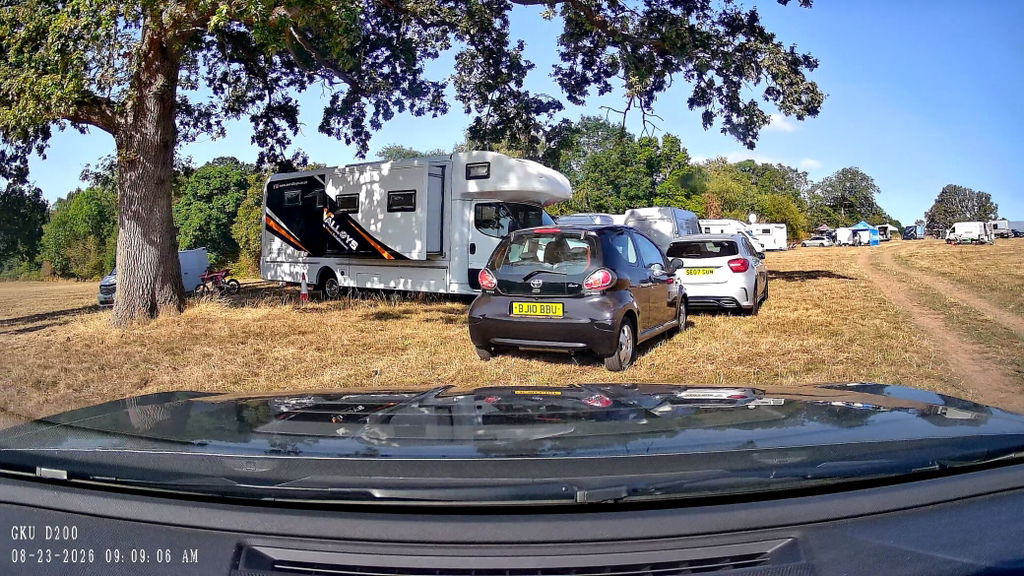
Real Footage
Explore the GKU D600 Pro Max →
Real-World Test: What Should You Look For?
When evaluating sample dash cam footage, don't simply ask:
“Does this video look sharp?”
Look specifically at difficult areas.
Bright Sunlight Test
Check:
- Is the sky completely white?
- Can you still see vehicles in shadow?
- Are road markings visible?
- How quickly does exposure recover?
Headlight Test
Check:
- How large are the blown-out areas around headlights?
- Can you still see the approaching vehicle?
- Are surrounding road markings visible?
- Does exposure remain stable?
Tunnel Test
Watch the transition:
Bright → Dark → Bright
A capable imaging system should adapt reasonably quickly without leaving the entire image unusable for an extended period.
License Plate Test
Look at plates under several conditions:
- Daylight
- Backlighting
- Night
- Oncoming traffic
- Moving vehicles
A single stationary daytime plate is not enough to evaluate real-world dash cam performance.
Final Thoughts: Good Glare Control Is About the Whole Imaging System
Bright sunlight and headlights are difficult for every camera because they create extreme differences in brightness.
Modern dash cams manage these conditions through several technologies working together:
Image Sensor → Dynamic Range → HDR/WDR → ISP → Exposure → Lens
No individual specification guarantees perfect footage.
HDR cannot eliminate every headlight.
4K cannot guarantee every license plate will be readable.
And a high-quality sensor still needs effective image processing.
That's why the best way to evaluate a dash cam is to look at both its imaging technology and its real-world footage.
If you regularly drive at night, during sunrise or sunset, through tunnels, or in changing weather, prioritize a dash cam designed to preserve useful information across both bright highlights and dark shadows.
Because when dash cam footage becomes evidence, balanced exposure can matter just as much as resolution.
Frequently Asked Questions
1. How do dash cams reduce headlight glare?
Dash cams can reduce the effects of headlight glare through a combination of HDR or WDR, image sensor performance, automatic exposure control, image signal processing, and lens design. These technologies help preserve more detail when very bright headlights appear against a dark road.
2. Does HDR reduce headlight glare?
HDR can help control bright highlights and preserve shadow detail in high-contrast scenes. However, it cannot completely eliminate headlight glare in every driving condition.
3. Why does my dash cam look blurry in bright sunlight?
Possible causes include direct sunlight, lens flare, windshield reflections, a dirty windshield or lens, motion, exposure limitations, or the camera's dynamic-range performance.
4. How do I reduce sun glare on my dash cam?
Keep the windshield and camera lens clean, reduce reflective objects on the dashboard, check camera positioning, and consider a compatible CPL filter if windshield reflections are a major problem.
5. Does a CPL filter reduce dash cam glare?
A CPL filter can be useful for reducing certain windshield and dashboard reflections during daytime driving. However, because it also reduces some incoming light, it is not a universal solution for nighttime headlight glare.
6. Why are license plates white at night on my dash cam?
Reflective license plates can return a large amount of light toward the camera when illuminated by headlights. If the reflected light exceeds the camera's usable highlight range, parts of the plate may become overexposed.
7. Is HDR or WDR better for a dash cam?
Both terms describe approaches to handling scenes containing bright and dark areas, but implementation varies by camera. Instead of choosing solely based on the label, evaluate the camera's sensor, processing, exposure control, and real-world footage.
8. Does 4K help reduce glare?
4K does not directly reduce glare. It provides higher spatial resolution, while glare performance depends more heavily on dynamic range, sensor quality, exposure control, HDR/WDR, lens quality, and image processing.
9. Why is headlight glare worse when it rains?
Wet roads reflect headlights, streetlights, signs, and other light sources, creating more bright areas within a dark nighttime scene. This increases the dynamic-range challenge for the camera.
10. What is the best dash cam feature for headlight glare?
There is no single feature that solves headlight glare. A strong combination of a high-quality image sensor, effective HDR or WDR, well-tuned exposure control, advanced image processing, and good optics generally provides the best results.
0 comments